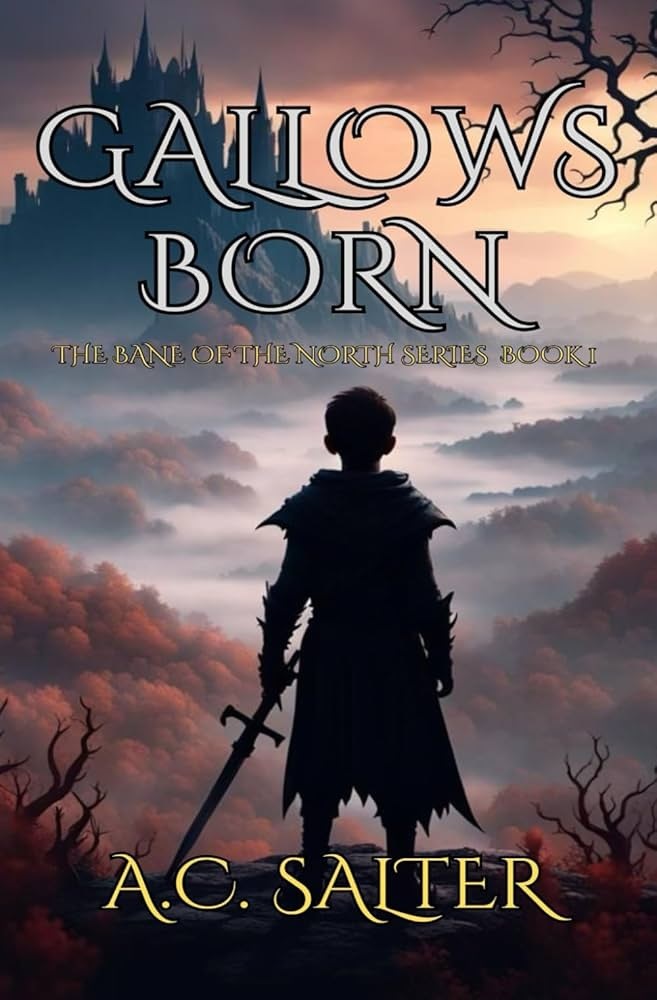
This book was one that came up on my Facebook feed when I was browsing through. The blurb was intriguing, even though the plot wasn’t hugely original, so I decided to give it a try.
The opening scene of the book was pretty tense, with a young woman being accused of stealing from the castle and about to be executed for it. Right from the start, it’s obvious that there’s a lot more to the execution than the so-called crime Nel committed. This is partly due to Gelwin’s protestations of her sister’s innocence…and partly due to the fact that Nel, upon being executed, gives birth to a little boy, which is, of course, where the title of the book comes from.
Bane’s life in Crookfell is fairly typical of a main character in a fantasy book. He’s an outcast, with a dead mother and a dead guardian…his only living guardian is physically and verbally abusive…and everyone in the town hates him. He also has a special marking, or tattoo, on his arm that marks him in some way and is later important to the plot.
Despite the large amount of cliches, I found Bane to be a character who was easy to empathise with. I also really appreciated that, while there are some elements of ‘you can fight so well because it’s in your genes’, he’s actually trained to fight and it’s in a way that makes sense, in spite of being used as a literal punching bag during one of his (many) bullies’ own attempts at training.
I really wasn’t a fan of the romance that seemed shoehorned into this book. Belle seemed to follow the whole Cinderella trope, but I didn’t find her to be an interesting character. I knew barely anything about her, apart from what Bane so, so she didn’t feel ‘real’ to me. On the other hand, Alruna had more depth to her…but I’m really not a fan of the whole enemies to lovers trope, especially as the whole reason Alruna hates Bane is because he killed her brother to save his own life. I have a serious problem with people who want others to suffer/die when their only ‘crime’ was defending themselves…and, in Bane’s case, the rest of his town.
The idea of the Fug was quite an intriguing one, especially with how it related to Vikings and Norse mythology. I liked the fact that it wasn’t all revealed at once, instead being shown gradually as the book went along.
On the whole, I did find this book easy to read…but Bane was the only character I really felt any real connection to. I did like Gelwin, but as she only appeared at the start of the book, I didn’t really form a connection with her. If you like fantasy that’s easy to read and fairly engaging, this book is probably worth reading. At some point in the future, I’d probably be interested in reading the next books in this series.









 Ink of Blood