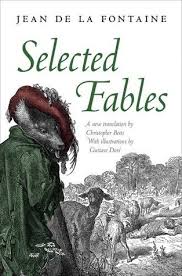
(I received this book for free as part of Goodreads First Reads giveaways).
(This review may contain spoilers).
To be honest, I don’t tend to read poems very much. I sometimes find it difficult to relate to the style, even though they can sometimes be easier to read than narrative.
I’ve not actually read any of Aesop’s Fables, but I know one of the more famous ones. However, I could clearly see the inspiration that the original author of these fables took from Aesop, while still making these fables his own.
It’s interesting to see human emotions ascribed to animals in this. We do that quite a lot in speech – ‘loyal as a dog’; ‘curious (or clever) cat’; ‘crafty as a fox’.
I wonder, if animals could communicate with each other, what they would say. Would they be as they’re portrayed in these fables, or the complete opposite? I noticed that serpents seem constantly referred to as ‘evil’ here. Again, it’s interesting to see the human concept of good and evil used in animals when most people use the fact that animals can’t think or reason (supposedly) as excuses why they can be mistreated.
I think society, as a whole, can learn a lot from fables like these. The morals were good to read and some of them were a bit surprising – as were the endings to the stories. Not all of them, but some were a little unexpected.
The main focus on this collection of fables seems to be about greed. Misers, people wanting more than they’ve got and not being content with what they have… as true as that probably was in the author’s time, in a way, I’d say it’s even worse now. How different would our world be if people learned the lessons from these fables?
I’m not sure what I’ve written here has made a lot of sense. These fables were cleverly written and entertaining to read even now, years after they were written. This book has definitely piqued my interest in looking at other fables in the future.


 Ink of Blood